
- Home
- Research standards
- Office of the Academic and Research Integrity Committee
Office of the Academic and Research Integrity Committee
Holding the belief that “well begun is half done”, Chulalongkorn University is determined to produce academic and research works with real-world impacts by fostering the development of faculty, students, and staff members to thrive in their career whilst being keenly aware of applicable academic and research ethics. Not only does such a mission serve as an overarching principle guiding Chulalongkorn faculty, students, and staff members from pre- through post-research stages, but it also helps promote the production of first-rate research works that enhance the reputation of Chulalongkorn University.
To this end, Chulalongkorn University appointed the Academic and Research Ethics Committee on June 26, 2020 to be in charge of formulating and pursuing a policy for the promotion of internationally recognized academic and research ethics. This is a key milestone for Chulalongkorn University in both complying with internationally recognized academic and research ethics and safeguarding its faculty, students, and staff members against any breach of ethics, either intentionally or inadvertently.
The Academic and Research Ethics Committee also aspires to afford new and experienced researchers access to beneficial information and activities that will assist them in producing impactful academic and research works meeting internationally recognized standards to foster pride in their research career at Chulalongkorn University.
The Academic and Research Ethics Committee of Chulalongkorn University is a standing committee appointed and supervised by the Chulalongkorn University President to perform its duties with the aim of devising, enforcing, and fulfilling internationally recognized standards for the dissemination of academic and research works in line with Chulalongkorn University’s policy.
The Academic and Research Ethics Committee is also in charge of considering complaints about the dissemination of the academic or research works of Chulalongkorn University faculty, students, or staff members that may potentially constitute a violation of ethical standards, including, but not confined to, the following:
- Fabrication
- Falsification
- Plagiarism
- Misconduct in authorship\
- Other types of infringement as deemed necessary by the Chulalongkorn University President

Operational Standard Policy
Chulalongkorn University commits itself to supporting, promoting, and defending internationally recognized standards for academic and research ethics through its policy as follows.
- Chulalongkorn University expects its faculty, students, and staff members to comply with the highest ethical standards for academic and research works from the stage of production through the communication or dissemination of their works.
- Chulalongkorn University allocates the necessary infrastructure, resources, and environment to support and promote the compliance of its faculty, students, and staff members with internationally recognized standards for academic and research ethics.
- Chulalongkorn University has a mission to raise awareness of academic and research ethics among its faculty, students, and staff members.
- Chulalongkorn University puts in place a mechanism for handling petitions on academic and research ethics in an efficient, transparent, and fair manner.
- Chulalongkorn University continuously promotes collaboration to strengthen the efforts to uphold academic and research ethics.
The Academic and Research Ethics Committee of Chulalongkorn University has developed the standard operating procedures of the Academic and Research Ethics Committee. The University has announced them as guidelines since July 18, 2022. The objectives are to develop and promote research to be of quality, standard, and reliable, in line with research ethics and relevant laws, using them as a framework for determining the powers and duties of the committee, the composition and acquisition of the committee, and the committee’s operations.
Academic and Research Integrity Committee
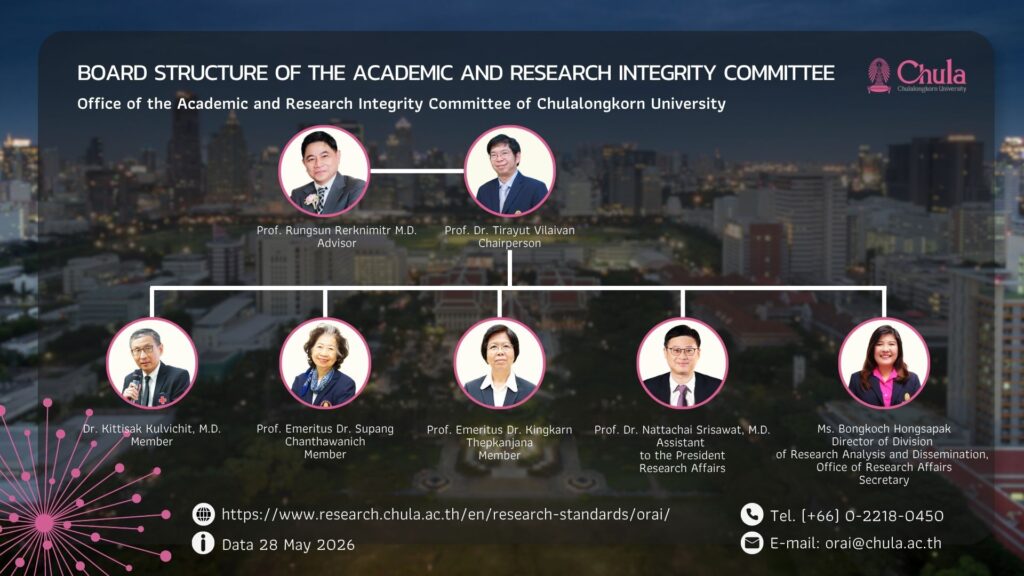
- Professor Dr. Rungsun Rerknimitr, Vice President – Advisor
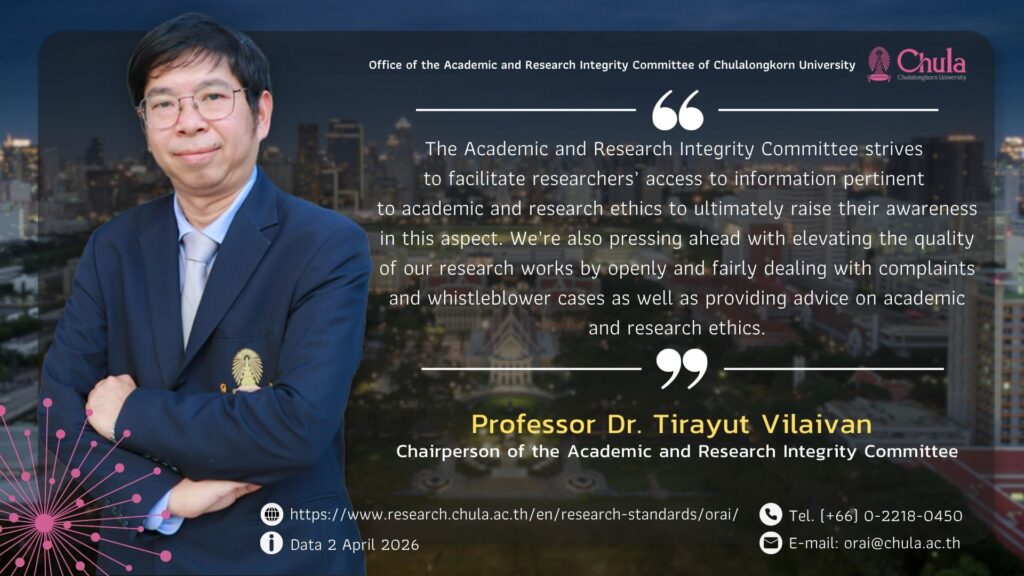
- Professor Dr. Tirayut Vilaivan – Chairperson
- Professor Emeritus Dr. Supang Chanthawanich – Member
- Professor Emeritus Dr. Kingkarn Thepkanjana – Member
- Dr. Kittisak Kulvichit, M.D. – Member
- Professor Nattachai Srisawat, M.D., Ph.D., Assistant to the President
- Director of Division of Research Analysis and Dissemination, Office of Research Affairs – Secretary
- Officer of the Secretariat Office of the Academic and Research Integrity Committee – Assistant Secretary
Scope of duties of the Academic and Research Ethics Committee
- To provide knowledge and understanding of academic and research ethics among university personnel and students.
- To receive consultations, complaints, and reports of misconduct; to investigate, examine, and determine the facts in cases deemed appropriate by the committee; and to prepare a summary report of the complaint review, together with the committee’s opinions, to be submitted to the university president.
- Chulalongkorn University Announcement Subject: The Appointment of Academic and Research Interiority Committee (Click)
E-Learning
Researchers wishing to learn more about academic and research ethics to improve the quality and standard of their works are encouraged to take the online ethics courses delivered by the National Science and Technology Development Agency (NSTDA), a body tasked with creating an impetus for the production of academic and research works meeting national standards.
Registration can be done online via NSTDA’s Career for the Future Academy’s (Thai version) link: https://www.career4future.com/elearn/
Currently, NSTDA offers free of charge four online research ethics courses:
- Research Integrity 01 (course length: 11 minutes)
- Research Integrity 02 (course length: 11 minutes)
- Authorship (course length: 16 minutes)
- Research Record Keeping (course length: 3 minutes)
- Research Integrity (course length: 61 minutes)
- Artificial Intelligence Ethics (course length: 56 minutes)
To enroll, simply follow the five steps below:
- Sign up and sign in.
- Take the pre-test.
- Proceed to the lesson.
- Take the post-test.
- Receive the e-certificate.
- Online courses for free.
- Researchers completing a course will be issued an e-certificate lasting three years from the date of its issuance.

Petition
Scope of consideration of complaints
Office of the Secretariat Office of the Academic and Research Integrity Committee under the Division of Quality Promotion and Research Dissemination, Research Administration Office, Chulalongkorn University, accepts complaints on issues of violation of academic and research ethics. It is an agency that coordinates with the Committee on Academic and Research Ethics, Chulalongkorn University, in considering complaints through a legitimate complaint consideration process.
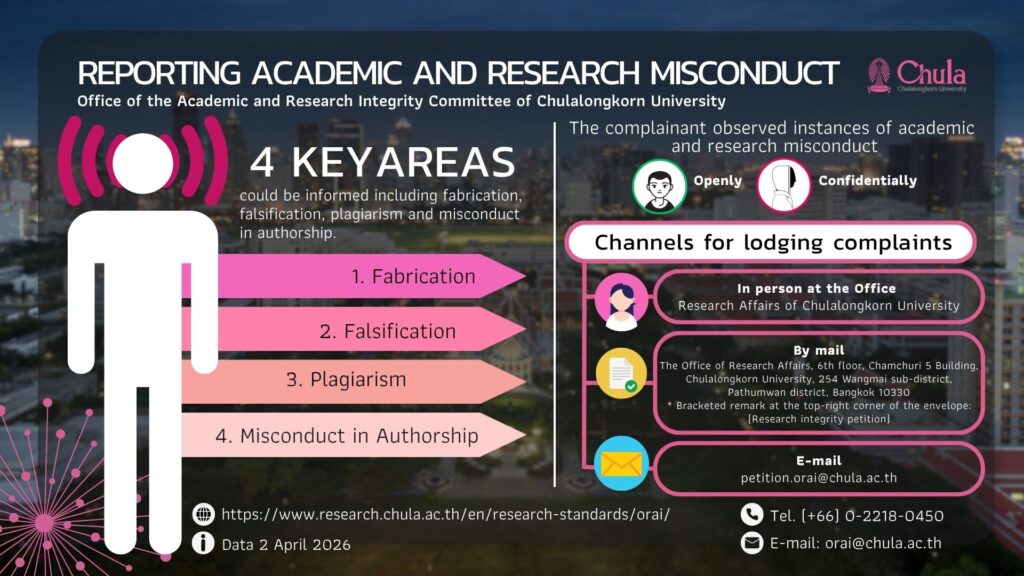
Any person who suspects that the academic or research works of Chulalongkorn University faculty, students, or staff members may potentially constitute a violation of ethical standards, including, but not confined to, fabrication, falsification, plagiarism, or misconduct in authorship, is encouraged to lodge a petition together with evidence of such a violation to the Academic and Research Ethics Committee.
How to lodge a petition
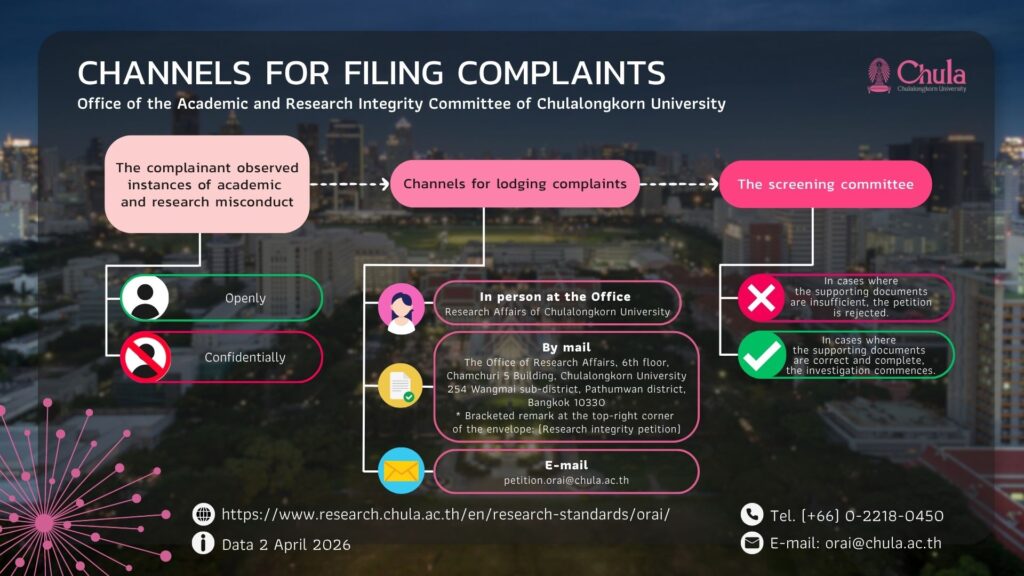
The petitioner can lodge a petition either openly or confidentially.
- How to lodge a petition
- Downloadable a petition form from our website. (Download the form here)
- Include in the petition the details of violation of academic and/or research ethics; the first name, surname, and affiliation of the respondent; and supporting evidence for the consideration of the Academic and Research Ethics Committee. In the event that the petitioner wishes to lodge the petition openly, s/he should also include his/her first name, surname, and contact information.
- Channels for lodging a petition
- Lodge the petition in person at the Secretariat Office of the Academic and Research Ethics Committee, Division of Research Analysis and Dissemination, Office of Research Affairs.
- Mail the petition to the Secretariat Office of the Academic and Research Ethics Committee, Division of Research Analysis and Dissemination, Office of Research Affairs.
- E-mail the petition to petition.orai@chula.ac.th
Petition review procedure
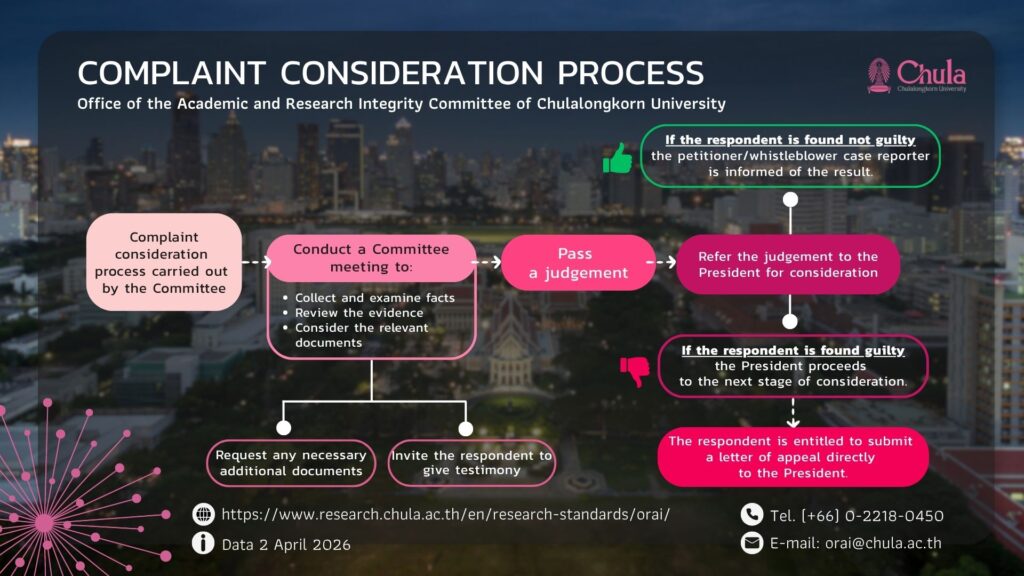
In considering a petition, the Academic and Research Ethics Committee follows the procedure below.
- The Academic and Research Ethics Committee investigates the petition based on all the documents and evidence submitted by the petitioner. The petitioner and/or respondent may be invited to give testimony to be used as part of the review process. In the event that the respondent is not invited to give testimony, s/he can exercise his/her own discretion in choosing to do so.
- The Academic and Research Ethics Committee convenes a meeting to discuss and pass a resolution on the petition. A unanimous decision on the petition will be the judgement to be reported to the Chulalongkorn University President and notified to the petitioner within 10 working days.
- The petitioner or respondent is entitled to appeal the decision of the Academic and Research Ethics Committee in writing directly to the Chulalongkorn University President, who may choose to establish another working committee to review the appeal, return the appeal to the Academic and Research Ethics Committee for reconsideration, reject the appeal, or take any other action, as deemed appropriate.
- Download the Petition review procedure (click)
Academic and Research Ethics Manual
- Download Information Kit : Misconduct of Research Integrity (click)
Frequently asked questions
Is it illegal to buy research or have someone else do research on your behalf?
- It is illegal according to the Higher Education Act of 2019, Section 70, which states that:
“For the benefit of maintaining the standards of higher education, good governance and academic honesty, no person shall hire, ask or use another person to produce academic work for use in presenting as part of the study in the higher education curriculum or for use in producing work which is part of the application for an academic position or for submitting a request for adjustment of the determination of a position, promotion, advancement of academic status or granting a higher salary or other compensation, regardless of whether there is any benefit in return or not. No person shall be hired or undertaken to act in accordance with paragraph one in order for another person to use that work for the purpose of performing the work in accordance with paragraph one, except in the case of providing assistance in good faith as appropriate. Section 77 Whoever violates Section 70 shall be liable to imprisonment not exceeding 3 years or a fine not exceeding 60,000 baht, or both.”
- In addition, there is an announcement on research standards by the National Research Council of Thailand (NRCT) specifying the standards for publishing research and academic work, including researcher ethics. Therefore, it is a violation of academic ethics for researchers to publish academic work by purchasing work in order to have their names included in research articles published in international academic journals.
Information from : https://www.moj.go.th/view/81686
Contacts
Officer
Call (+66) 0-2218-0450
Line @cu.research
E-mail: orai@chula.ac.th
Address
Office of the Academic and Research Ethics Committee
Chamchuri 5 Building, Chulalongkorn University, 254 Phyathai Road, Pathumwan, Bangkok 10330 Thailand

