- Home
- TRIUP-ACT
TRIUP-ACT
Amidst the challenges of transforming knowledge into economically valuable outcomes, the government has recognized the importance of restructuring ownership of research results. By granting ownership to the professors and researchers who create the work, it aims to create incentives and increase commercial competitiveness. This concept is derived from the Bayh-Dole Act of the United States, which led to the enactment of Thailand’s Research, Innovation and Utilization Promotion Act B.E. 2564 (2021). Effective since May 7, 2022, this Act establishes a new foundation for Thai research and innovation to be utilized more tangibly.
Objectives
- Allows grantees or researchers to own research results funded by the state.
- Establishes criteria for transferring research and innovation results from the owner to other parties and defines the duties of the transferee.
- Empowers the Prime Minister to order designated agencies to utilize research and innovation results arising from state funds in cases of emergency or crisis.
- Requires owners of research and innovation results to utilize, manage, and report the utilization results to the funder.
- Allows those wishing to utilize research and innovation results to request permission by proposing terms and compensation.
- Designates agencies, methods for promotion, and the allocation of compensation to researchers to encourage the widespread use of appropriate technology.*
* Information from https://www.tsri.or.th/nsrf/triup/triup-act
Related documents
Benefits of Submitting a Disclosure Report

Private Sector

Research Institutes, Universities, Researchers

Public, Farmers, Community Enterprises

Country
- Private entities capable of conducting their own research can request ownership of research results supported by the public sector.
- Startup/Spinoff companies can raise funds more easily due to owning the intellectual property.
- Reduces negotiation steps for licensing research and innovation with the owner (as funders are no longer involved).
- Research institutes, universities, and researchers can own research and innovation results.
- Can receive benefits generated from the utilization of research and innovation results.
- Reduces negotiation steps with the private sector, increasing the rate of research utilization.
- Can access appropriate technology to improve production processes and services, and generate more income (due to supporting budgets and mechanisms).
- Facilitates the transition to an innovation-based economy, reduces inequality, and generates income to escape the middle-income trap, as researchers are motivated to deliver innovation to users.
- Users can access innovation more easily, using it as a tool to drive the country forward.
Enforcement of the Act TRIUP Act
Applies to state agencies with the duty, power, or objective to provide research and innovation funding.
Exceptions:
- Exempt from the entire Act : Institutional research, funding for foreigners not residing in Thailand, weapons and military research (excluding dual-use), research of great benefit to the public or essential as a basis for further research, and other matters as prescribed by Royal Decree.
- Exempt only regarding ownership : Joint funding, funding by state universities using non-budgetary funds.
- Modified conditions as determined by the Policy Council : Funding for foreigners residing in Thailand (cases under this Act fall under the jurisdiction of the Intellectual Property Court).

Types of Research and Innovation Funding Subject to the Law
Research Funding Subject to the Law
- Funding from state agencies with the objective, duty, or power to provide research funding, or funding from funding agencies as announced by the Policy Council.
- Research and innovation funding using money from:
- National Budget
- Science, Research and Innovation (SRI) Promotion Fund
- Other funds or revolving funds with the objective of providing research support
- Full grants, matching grants, recoverable grants, or loans with a fixed repayment period to the funder.
Research Funding Not Subject to the Law
- Scholarships with conditions requiring research or innovation as part of the grant.
- Research and innovation funding characterized by:
- Consultancy hiring under the law on public procurement and supplies management.
- Other types of funding as determined by the agency, with the approval of the TSRI Board.
Frequently asked questions
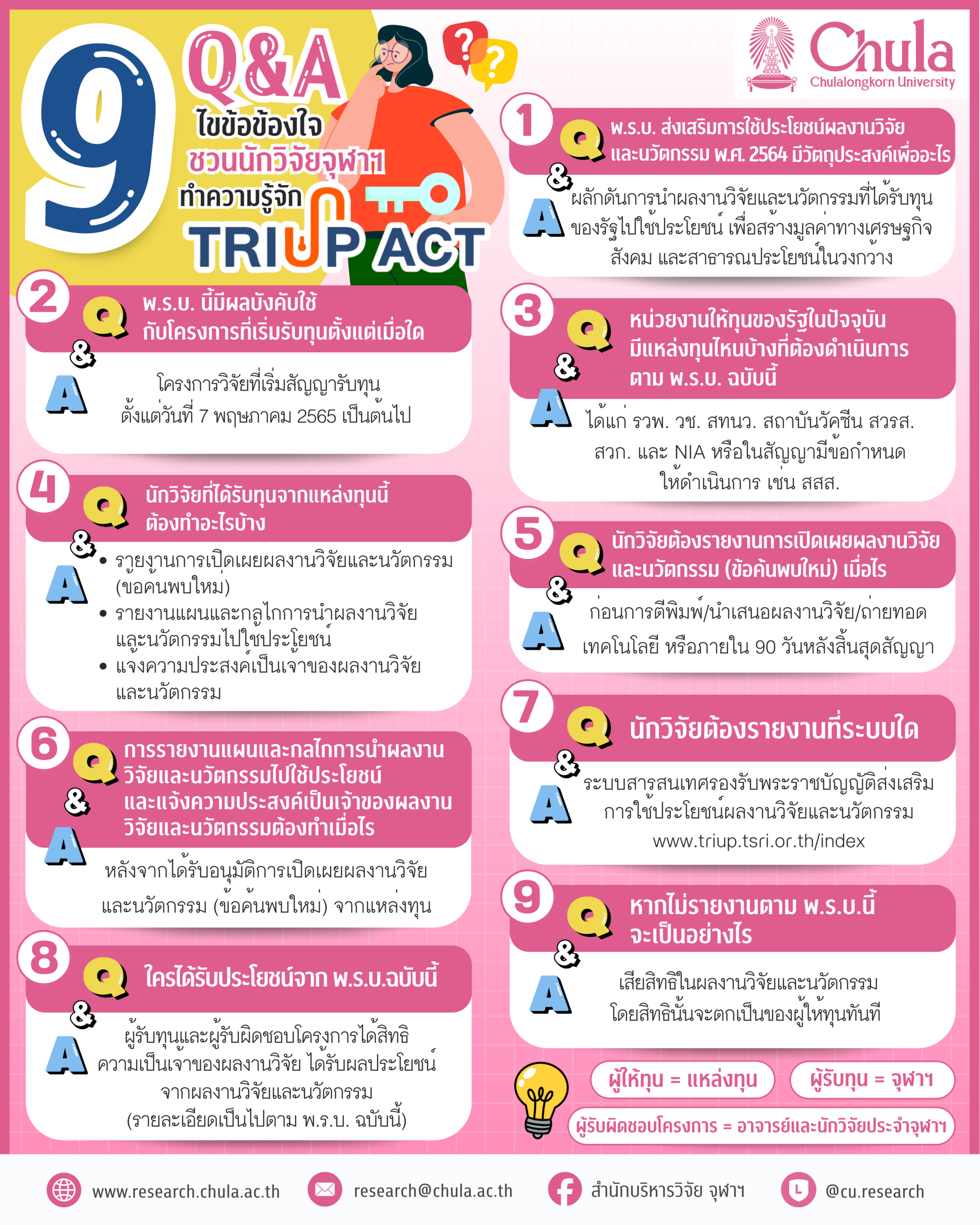
What is the objective of the Research, Innovation and Utilization Promotion Act B.E. 2564?
- To drive the utilization of state-funded research and innovation results to create economic, social, and public benefits on a broad scale.
When does this Act apply to projects starting their funding?
- Research projects with funding contracts starting from May 7, 2022, onwards.
What are the current state funding sources?
- Program Management Units (PMUs), including PMU B, NRCT, NIA, National Vaccine Institute, HSRI,
and ARDA. Or contracts with requirements to report utilization under the TRIUP Act, such as ThaiHealth.
What must researchers receiving funds from these sources do?
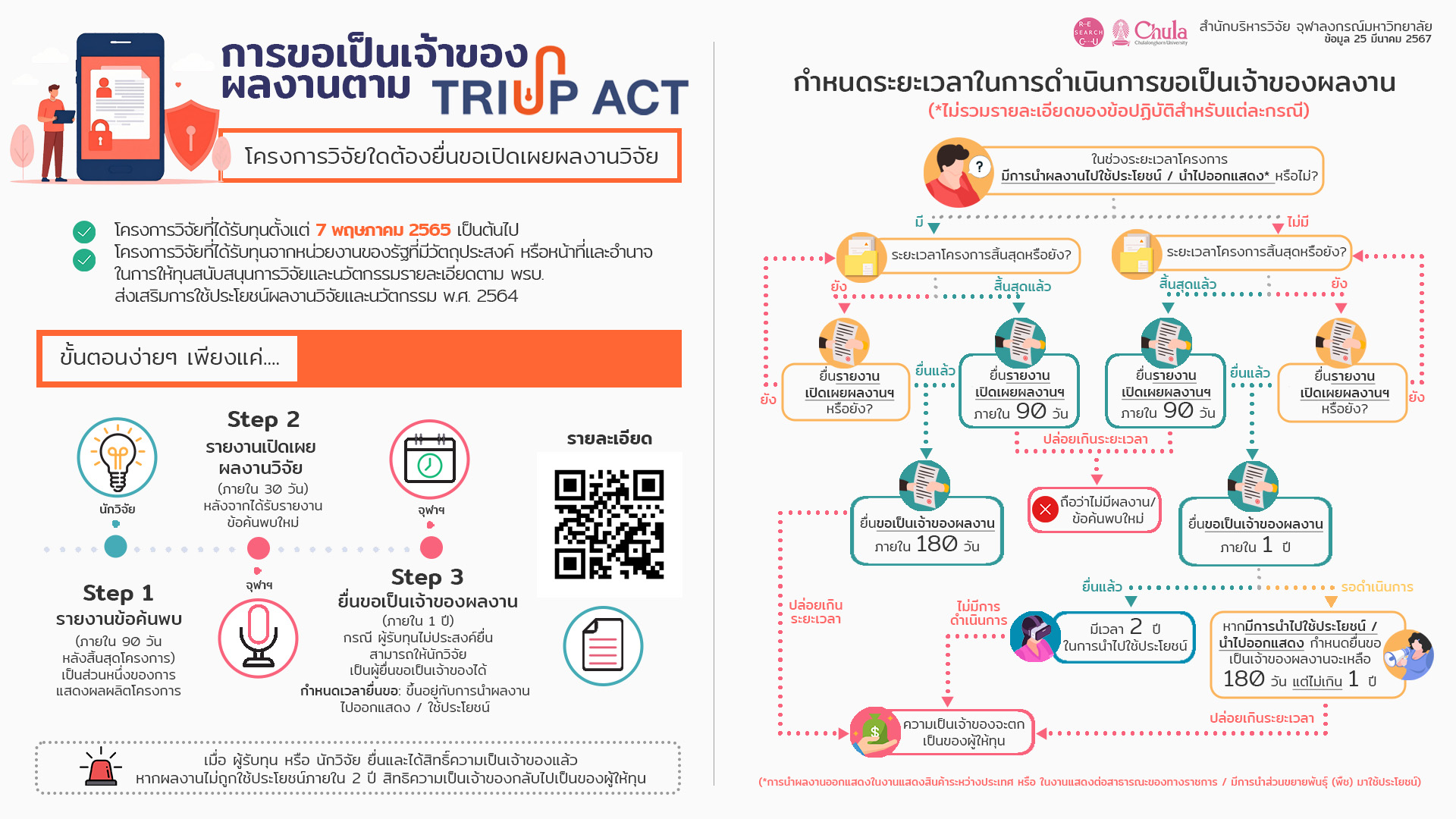
- Submit a Research and Innovation Disclosure Report (new findings).
- Report the plan and mechanism for utilizing research and innovation results.
- Notify the intent to own the research and innovation results.
When must researchers submit the Research and Innovation Disclosure Report (new findings)?
- Before publication, presentation, technology transfer, or within 90 days after the contract ends.
When must the reporting of the utilization plan and the notification of intent to own the results be done?
- After the Research and Innovation Disclosure (new findings) has been approved by the funding source.
Which system must researchers use for reporting?
- ระบบสารสนเทศรองรับพระราชบัญญัติส่งเสริมการใช้ประโยชน์ผลงานวิจัยและนวัตกรรม www.triup.tsri.or.th/index
Who benefits from this Act?
- Grantees and project leaders gain ownership rights and benefits from research and innovation results (details as per this Act).
What happens if reporting is not done according to the Act?
- Rights to the research and innovation results will be lost and will immediately revert to the funder.